
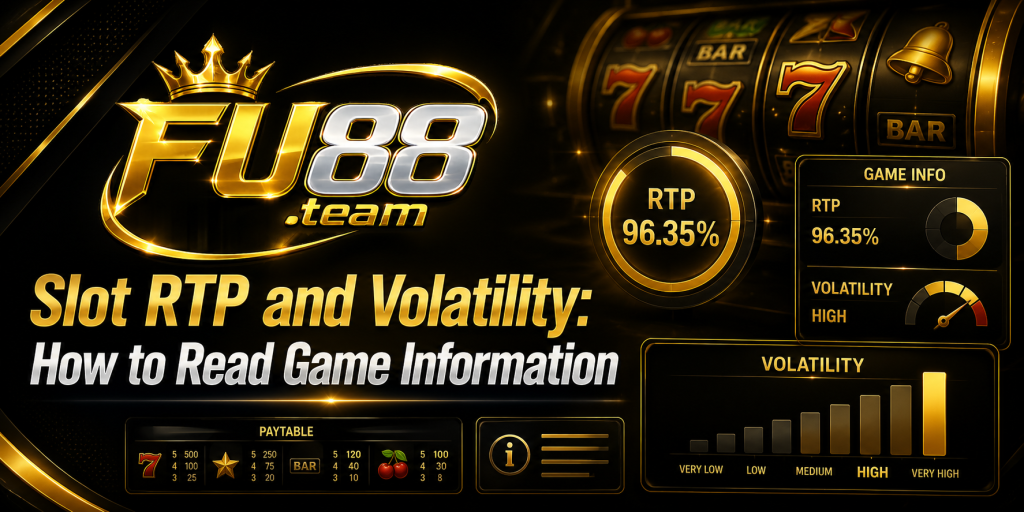
Slot RTP and volatility are two of the most common terms shown in slot information panels. They describe different parts of a game’s mathematical design, but neither figure can predict the result of an individual spin or guarantee what will happen during a short session.
Before selecting a title from the FU88 slot games section, users should open the game information and check the current version, theoretical return, volatility, paytable and feature conditions. These details provide context for the game format rather than a method for identifying the next result.
What Does Slot RTP Mean?
RTP stands for Return to Player. It is a theoretical percentage calculated across a very large number of game rounds under the rules of a particular slot version.
The percentage describes the long-term mathematical model. It does not state how much one user will receive, how many rounds are needed or when a winning combination will appear.
RTP Is a Long-Term Calculation
A slot may display an RTP percentage inside its help or information panel. That figure is based on the complete mathematical model of the game rather than one account, one day or one session.
Results over a small number of spins can differ greatly from the theoretical percentage. A short session may finish above or below the displayed RTP without changing the game’s stated long-term model.
RTP Does Not Apply Evenly to Every Session
The theoretical return is not distributed in equal portions. A game does not need to return a fixed percentage after a certain number of rounds.
For example, completing more spins does not create a personal entitlement to a particular result. Previous stakes, losses or winning rounds cannot be used to calculate what the next spin must produce.
RTP Is Not the Same as a Win Rate
RTP concerns the theoretical value returned across a large volume of play. It does not show how often a game produces a winning combination.
A title can record many small winning combinations while still using the same theoretical return as a game that distributes results less frequently but in wider amounts.
Why the Game Version Matters
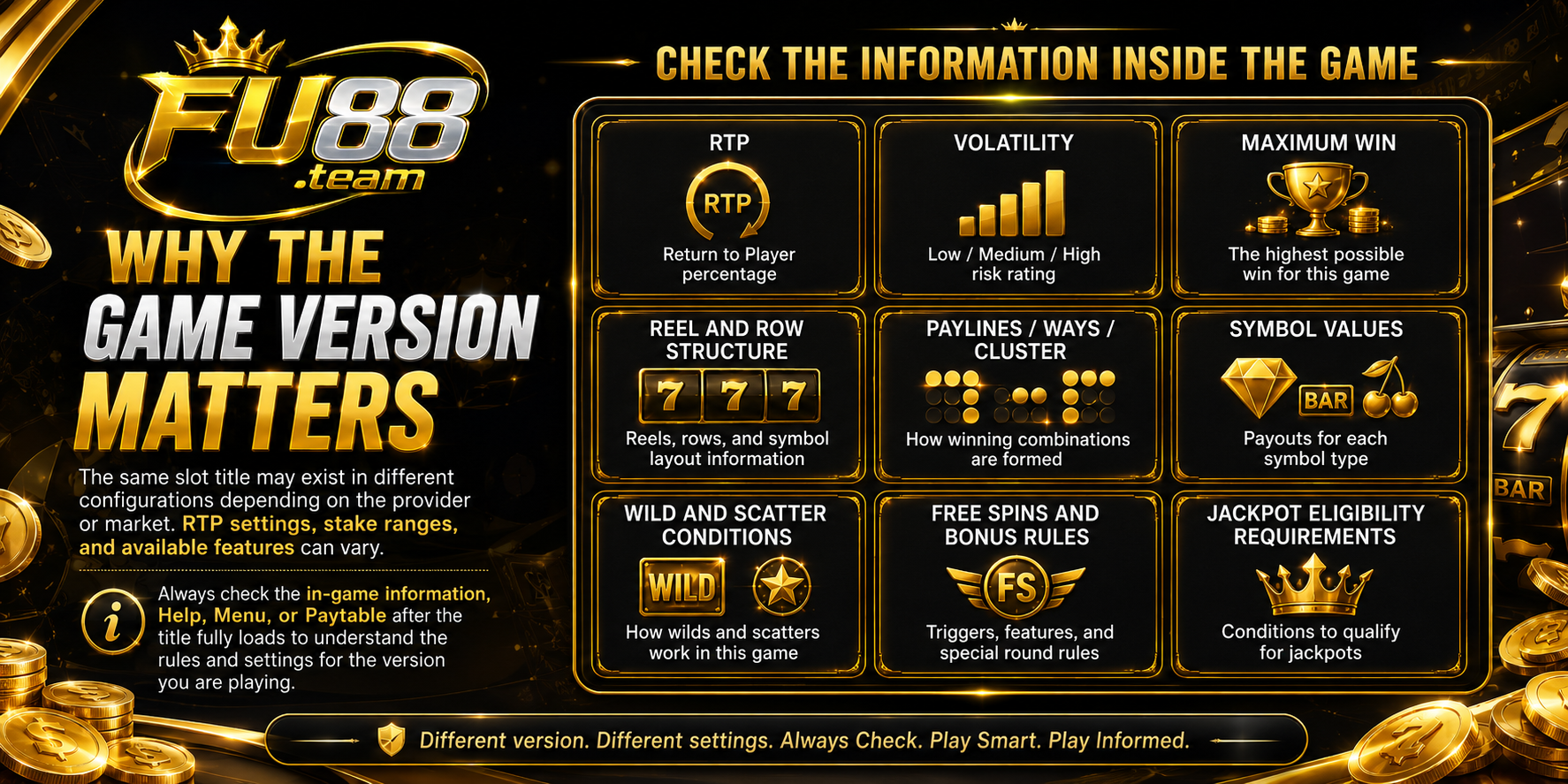
The same slot title may exist in more than one configuration. Different versions can use the same artwork and features while applying different RTP settings, stake ranges or market conditions.
For that reason, a percentage found in a review, video or unrelated website should not automatically be applied to the version currently open at FU88.
Check the Information Inside the Game
The current game interface should remain the primary reference. Look for an information, help, menu or paytable icon after the title has loaded completely.
The panel may display:
- The current RTP setting
- Reel and row structure
- Paylines, Ways or cluster rules
- Symbol values
- Wild and Scatter conditions
- Free Spins and bonus rules
- Maximum win information
- Jackpot eligibility requirements
Do Not Combine Figures From Different Versions
A game review may describe a version offered in another market or under another configuration. Even when the title and artwork are identical, the displayed mathematical information may differ.
Only use the details shown inside the version currently being played. When the RTP cannot be located, do not replace it with an unverified number from another source.
What Does Slot Volatility Mean?
Volatility describes the general way a slot distributes its possible results. It is sometimes labelled variance, although the two terms may be presented differently depending on the game information.
Volatility does not show whether a game is currently hot, cold or close to activating a feature. It describes the game model, not the condition of the next round.
Lower Volatility
A lower-volatility slot may distribute results in a narrower range. Its design may include more regular combinations with smaller differences between individual outcomes.
This does not mean that every session will contain frequent wins or that the balance will remain stable. The result of each round remains uncertain.
Medium Volatility
A medium-volatility label generally indicates a balance between smaller regular combinations and less frequent feature results.
The term is descriptive rather than predictive. Two medium-volatility titles can still use different paylines, bonus structures and maximum-win limits.
Higher Volatility
A higher-volatility slot may distribute results across a wider range. It may involve longer gaps between certain features or larger differences between recorded wins.
A higher-volatility label does not mean the game will produce a large result after a losing sequence. There is no reliable countdown showing when a feature must activate.
Is Low or High Volatility Better?
Neither category is automatically better. The more suitable option depends on the preferred game format, available entertainment budget and tolerance for result variation.
Users who prefer longer sessions may choose a stake and game structure that consume the planned budget more gradually. Those who select a higher-volatility title should still avoid increasing the stake in response to a sequence of empty rounds.
The slot bankroll management guide explains how to set a session budget, choose a stake and review the closing result without relying on predicted game cycles.
RTP and Volatility Are Different
RTP describes a theoretical long-term return model. Volatility describes the general distribution and variation of possible results.
| Game Information | What It Describes | What It Cannot Do |
| RTP | The theoretical long-term percentage calculated across a large number of rounds | Predict the return from one spin or short session |
| Volatility | The general spread and variation of game results | Identify when a bonus or winning combination will appear |
| Hit Frequency | How often a qualifying result may occur within the game model | Show the value of the next result |
| Maximum Win | The highest result permitted under the stated game rules | Guarantee that the maximum can be reached during a session |
A game may have a similar RTP to another title while using a completely different volatility level, hit frequency and bonus structure.
What Is Hit Frequency?
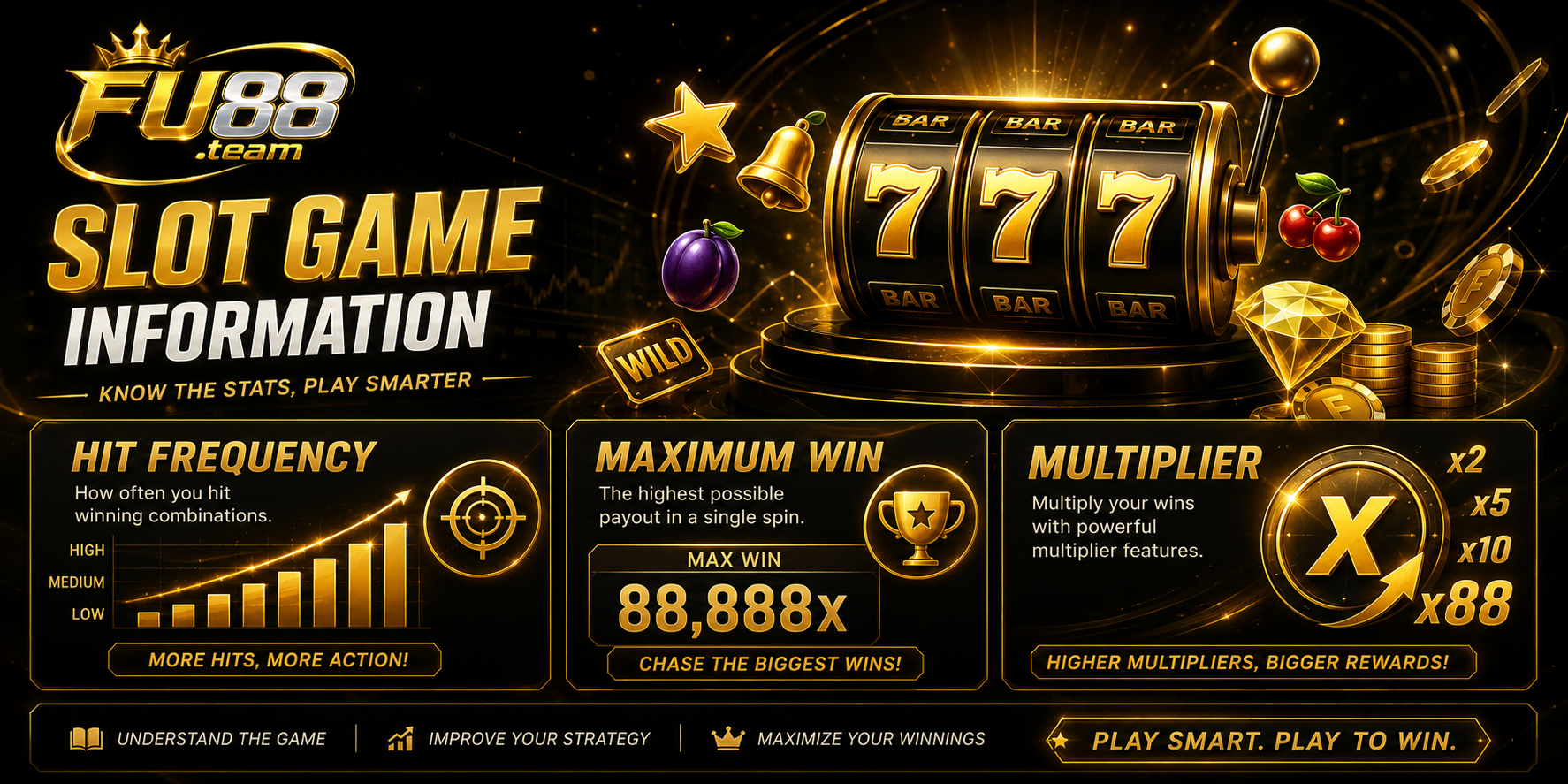
Hit frequency describes how often the game model produces a qualifying result. The exact definition may vary, so users should check whether the figure includes all recorded wins, bonus activations or another stated event.
Frequent Hits Do Not Mean Higher Profit
A game can produce frequent low-value combinations without creating a positive result for the complete session.
The total stake used across all rounds must be compared with the recorded returns. Counting the number of winning animations alone does not show the net session result.
Hit Frequency Does Not Show Win Size
The figure describes frequency rather than value. A qualifying result may be lower than, equal to or higher than the stake for that round.
Users should check Bet, Win and Balance values instead of treating every visual celebration as a profitable round.
Maximum Win and Maximum Multiplier
Some slot information panels display a maximum win, maximum multiplier or prize limit. This figure represents the highest result permitted under the stated rules.
It is not an average result and should not be interpreted as an expected return.
Maximum Multiplier
A maximum multiplier may be written as a multiple of the round stake. The monetary value therefore depends on the Total Bet used for the qualifying round.
The game may also apply an overall maximum-win limit that ends a feature after the permitted value has been reached.
Feature-Specific Limits
A limit may apply to the base game, Free Spins, a purchased feature or the complete round. Read the associated rule carefully before comparing figures between titles.
Two games displaying the same maximum multiplier may use different activation conditions and stake calculations.
How Bonus Features Affect the Game Model
Wilds, Scatters, Free Spins, multipliers and bonus rounds form part of the game’s overall mathematical design.
A displayed RTP percentage may include the contribution of these features across the complete model. It does not mean that every session will activate them.
Free Spins
Free Spins may use different reels, symbols or multipliers from the base game. Their conditions should be checked in the paytable.
Bonus Purchase
Some titles may provide an option to purchase access to a bonus feature. The displayed cost is normally higher than a standard base-game round.
Purchasing a feature does not guarantee that its result will exceed the amount paid. Check whether the information panel displays separate mathematical details for the base game and feature purchase.
Jackpot Features
A fixed or progressive Jackpot may use separate eligibility rules. It may require a minimum stake, active paylines or a particular bonus event.
The Jackpot meter and RTP describe different information. A changing meter does not reveal when the prize will activate.
How to Read Slot Game Information Step by Step
- Open the selected slot and wait until it loads completely.
- Confirm the full game title and current version.
- Open the information, help or paytable panel.
- Check the RTP shown inside that version.
- Review the volatility or variance label when available.
- Identify the paylines, Ways or cluster system.
- Read the Wild, Scatter and bonus conditions.
- Check the stake range and Total Bet calculation.
- Review the maximum win and any feature limits.
- Close the panel only after the main rules are understood.
The how to play slot games guide covers reels, paylines, Ways, symbols, paytables and recorded round results in greater detail.
How to Compare Two Slot Games
Comparing titles should involve more than choosing the one with the larger RTP figure. The complete game structure affects how the experience is presented.
Check the following information:
- Current game version
- Displayed RTP
- Volatility level
- Hit-frequency definition
- Minimum and maximum stake
- Payline, Ways or cluster format
- Free Spins and bonus conditions
- Jackpot eligibility
- Maximum-win limit
- Autoplay and Turbo controls
A game with a slightly different theoretical percentage may use a format that better matches the planned session budget. The figures should be read together rather than used as isolated rankings.
Common RTP and Volatility Myths
A High RTP Guarantees a Better Session
No. RTP is calculated over a large number of rounds and cannot guarantee the result of one session.
A Game Must Return Its RTP After a Certain Number of Spins
No fixed number of personal spins forces the game to match its theoretical long-term percentage.
High Volatility Means a Large Win Is Due
High volatility describes wider result variation. It does not create a countdown to a large result.
A Long Losing Sequence Means the RTP Will Correct Itself
Previous results do not create an individual debt that must be returned during the next rounds.
Playing Faster Changes the RTP
Turbo and Quick Spin shorten animations. They do not change the RTP displayed for the current game version.
Changing the Stake Resets the Game Cycle
Changing the stake alters the amount used for the next round. It should not be treated as a method for resetting or controlling a hidden payout cycle.
Using Game Information Responsibly
RTP and volatility help users understand the mathematical description of a slot, but they cannot remove uncertainty.
Set a fixed entertainment budget before starting. Choose a stake that fits that budget and stop when the planned time or spending limit has been reached.
Do not continue because a bonus appears close, the Jackpot meter has increased or previous rounds were unsuccessful. None of these observations confirms what the next spin will produce.
Frequently Asked Questions
What Is a Good RTP for a Slot Game?
There is no single percentage that guarantees a suitable result. Users should consider the current version, volatility, game format, stake range and feature rules together.
Can RTP Predict My Session Result?
No. RTP is a theoretical long-term calculation and does not predict the outcome of an individual session.
Does High Volatility Mean the Game Pays More?
Not necessarily. It generally describes wider variation in possible results rather than a guaranteed higher return.
Can Two Versions of the Same Slot Have Different RTP?
Yes. Similar-looking versions can use different mathematical configurations. Check the information inside the current game.
Is Hit Frequency the Same as RTP?
No. Hit frequency concerns how often a qualifying result may occur, while RTP describes the theoretical long-term return model.
Does a Maximum Win Show What I Can Expect?
No. It shows the highest result allowed under the stated rules, not an average or expected session result.
Conclusion
Slot RTP and volatility describe different elements of a game’s mathematical structure. RTP concerns the theoretical long-term return, while volatility describes the general variation and distribution of possible results.
Neither figure can predict the next spin. Check the current game version, paytable, stake settings, bonus conditions and maximum-win rules before starting, then use a fixed entertainment budget rather than relying on theories about hot cycles or upcoming payouts.
